

Opticianry Troubleshooting
High Minus
With a strong minus prescription, the single biggest influence on how attractive the finished glasses turn out isn't the lens material or the lab work, it's the frame you choose.
Here's how to get the frame, the material and the edge treatment working together instead of against each other.
Pick the shape
Frame Selection
Minus lenses concentrate their thickness at the edges, so the frame shape has an outsized effect on the finished look. Smaller frames with rounded shapes keep that thickness to a minimum.
Avoid sharp angles and large lens shapes. An oval or rounded design lets the edge thickness taper evenly, which keeps the whole lens looking slimmer and more balanced.
If you want to hide a thick lens edge, a plastic (zyl) frame is your friend. The thicker frame naturally masks the lens edge. Some labs also offer edge camouflaging, painting or tinting the lens edge to blend in with the frame. This works far better than polishing and actually reduces glare instead of creating more.
Angular / Large
Thickness builds up fast at the corners
Round / Oval
Even edge thickness all the way around
Thinner by Design
Material Solutions
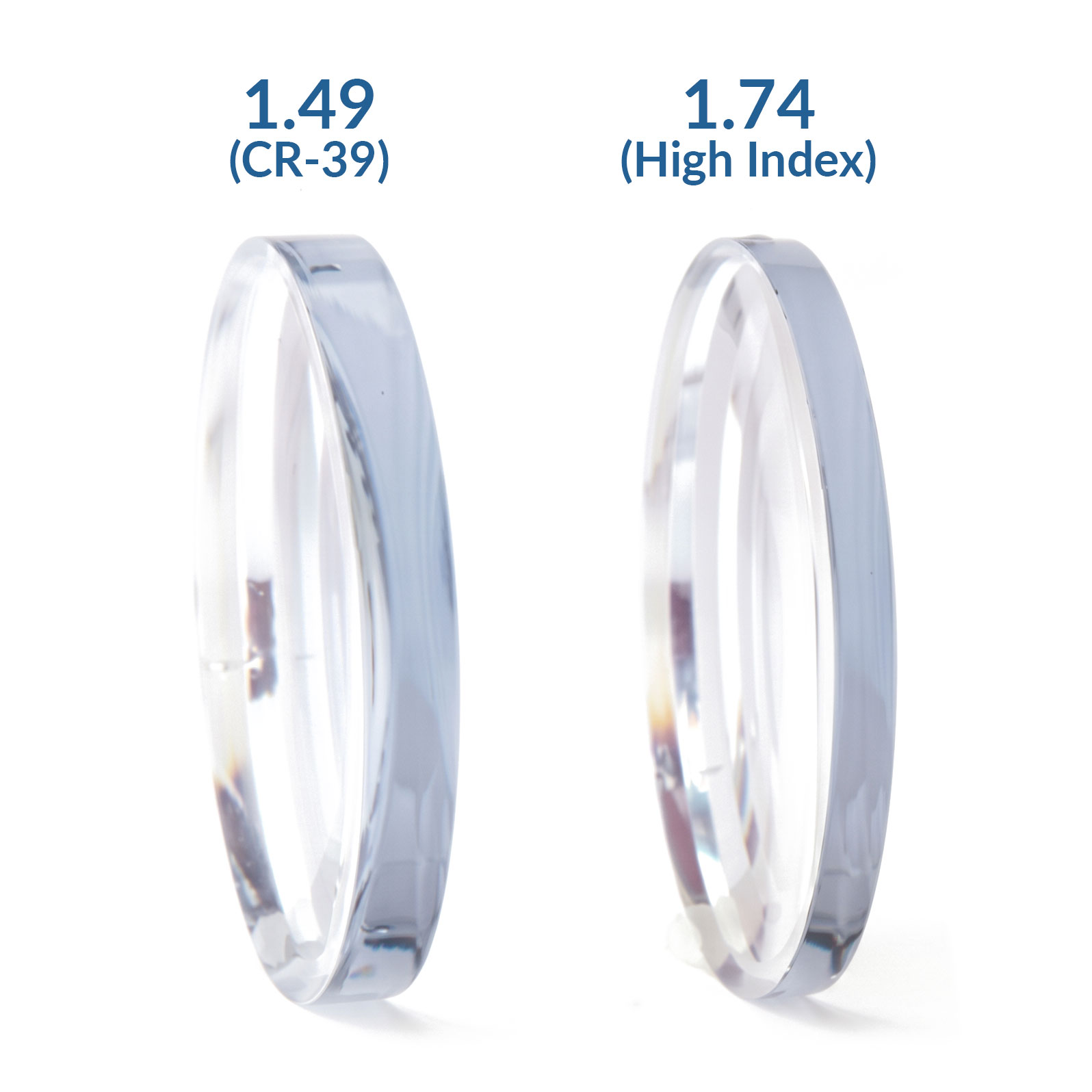
Once the frame is right, material choice does the rest. A high-index lens, such as 1.74, is roughly 33% thinner than a standard 1.49 index lens at the same prescription.
Another modern option is digital lens thinning, sometimes called lenticularization. This technology optimizes the center of the lens for clear vision and smooths out the periphery to reduce thickness. It won’t replace smart frame selection, but it helps when compromises have to be made.
Finishing Touches
Edge Treatment
Resist the urge to polish the edges. There’s a persistent myth that polishing the edges of a thick lens makes it look better. From the outside, maybe - but from the inside, it’s usually a bad idea. A polished edge acts like a tunnel for light, causing glare and reflections that can be distracting or uncomfortable.
Plastic frames naturally conceal a thick edge, so they're a safe default. For metal or rimless styles where the edge shows, edge camouflaging, tinting or painting the edge to match the frame, gives a cleaner result than leaving it bare.
Keep in Mind
Frame choice does most of the work here. Material and finishing are valuable supplementary fixes, but they can't fully compensate for the wrong frame shape.