

Principles of Vision
Central vs. Peripheral Vision
Ask someone about their eyesight and you'll probably hear about 20/20. It's the number everyone knows, and the one people are proudest of.
But 20/20 only describes a small part of how we see. Most of what keeps us moving, reacting and aware of the world around us happens outside that sharp center, in our peripheral vision.
quick Quiz
How Much of Your Visual Field Sees 20/20
Let's try a quick quiz. Pick one:
That's right. Just a tiny fraction of your visual field is actually capable of 20/20 acuity. The rest? That's your peripheral vision at work.
The Basics
What Is the Visual Field?
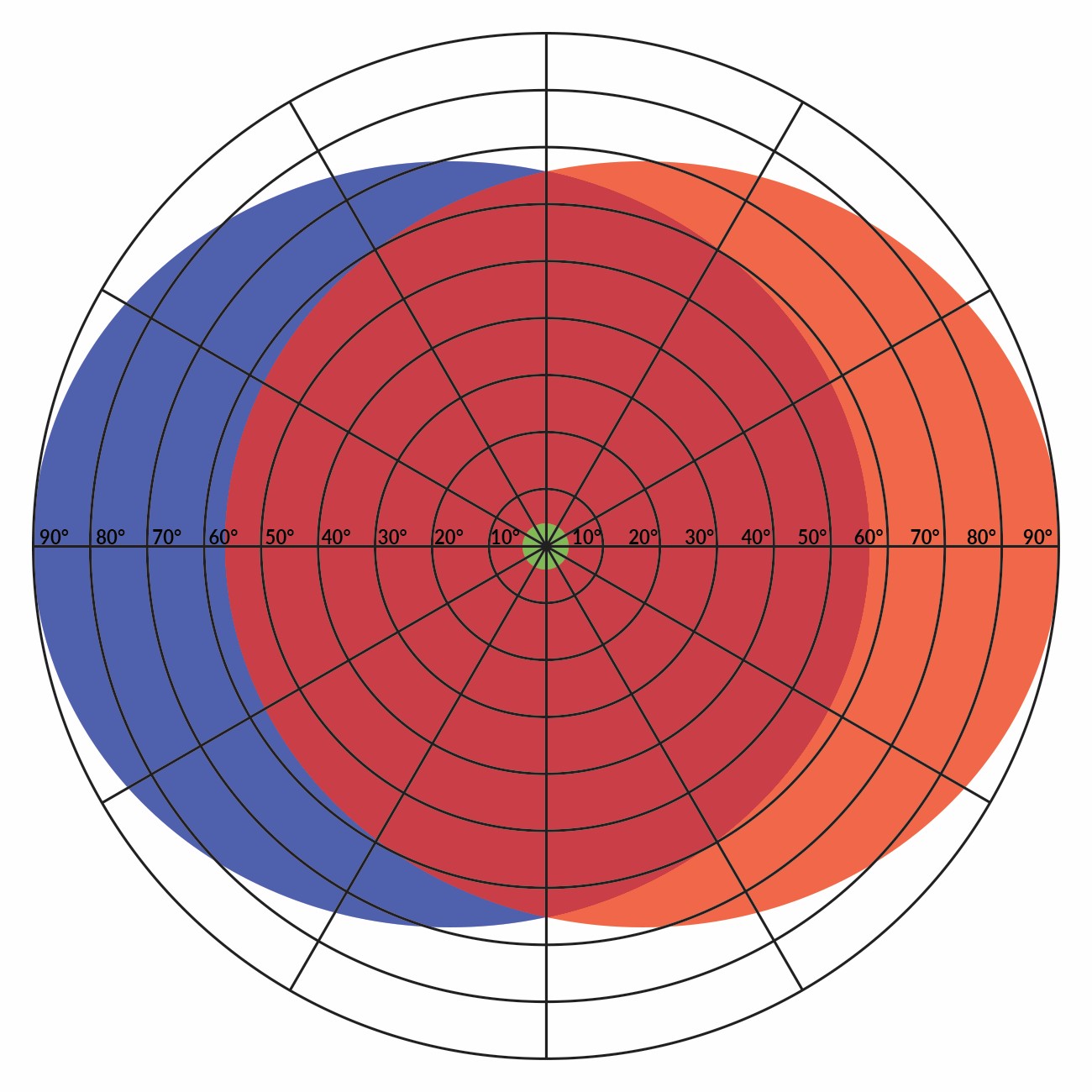
If you have normal eyesight, your horizontal visual field spans about 190 degrees. Imagine a full circle, your field of view is a little more than half that.
Each eye sees around 150 degrees.
There's a big overlap in the center where both eyes work together (binocular vision).
Try It At Home
You can try a simple test at home: Close one eye, look straight ahead, and slowly move your hand from the side toward your center of vision. That space where your hand first appears, that's part of your visual field.
Visual Acuity
Visual Acuity: Like a Bull's Eye
Think of your vision like a target:
- The center (fovea) is crystal clear and high-res. That’s where 20/20 happens.
- As you move out from the center, the image gets blurrier — that’s your peripheral vision.
Peripheral vision isn’t for reading — it’s for detecting motion, light, and contrast. It’s the reason you notice a dark shape in the corner of a white room or a flicker of movement as you walk by. Your peripheral vision is your visual radar. It tells your brain, “Hey, look over there!”
By the Numbers
Charting the Drop-Off in Vision
If you have normal eyesight, your horizontal visual field spans about 190 degrees. Imagine a full circle, your field of view is a little more than half that.
A chart like this shows how quickly your sharp vision fades. Most of what you "see" isn't crisp detail — it's shape, movement, and general awareness.
| Degrees from Fovea | Visual Acuity |
|---|---|
| 0° | 20/20 |
| 2° | 20/32 |
| 5–10° | 20/100 or worse |
The Science
Cone-driven retinal pathways
Many conditions can affect your vision without touching your acuity. People with:
- Concussions
- Strokes
- Peripheral vision loss
- Diabetes
- Glaucoma
…might still have 20/20 central vision — but serious problems in the rest of the visual field.
Here’s a comparison:
- Macular degeneration starts in the center and moves out.
- Retinitis pigmentosa starts in the periphery and moves in — causing “tunnel vision.”
Ironically, patients with advanced macular degeneration are often more mobile than those with late-stage retinitis pigmentosa.
The Takeaway
Don't Take Peripheral Vision for Granted
Peripheral vision does more than fill in the blanks. It helps you move, react, and survive, and it's massively underrated. So when a patient with 20/20 vision still complains of vision loss, you'll know it's just the tip of the iceberg.