

How Lenses Are Made
Mold-Making
Before a lens blank can be created, we have to start with the foundation: a pair of molds, one front and one back. These molds are what we use to form the “puck” that eventually becomes a prescription lens.
SMALL-BATCH, PRECISION WORK
The Chadwick Approach
For mass production, companies often use nickel electroplating, creating long-lasting molds that can produce thousands of lenses. But at Chadwick, we specialize in small-batch, precision work. That means we craft molds in-house using glass blanks surfaced right here in our lab - perfect for unique, one-off lenses.
Similar to processing prescription lenses, we start with a solid glass puck. Using precision cutting, we shape curves into the backside of the mold. For standard molds, we cut a single spherical curve.
For the more complex, we cut a curve on top of a curve.
Step 1
Blocking & Generating
Before cutting, the glass needs to be mounted. We attach a small block to the back of the puck using wax or alloy.
From there, the glass goes into a generator:
- The generator holds the lens securely.
- A diamond bit spins and moves to cut precise curves into the glass.
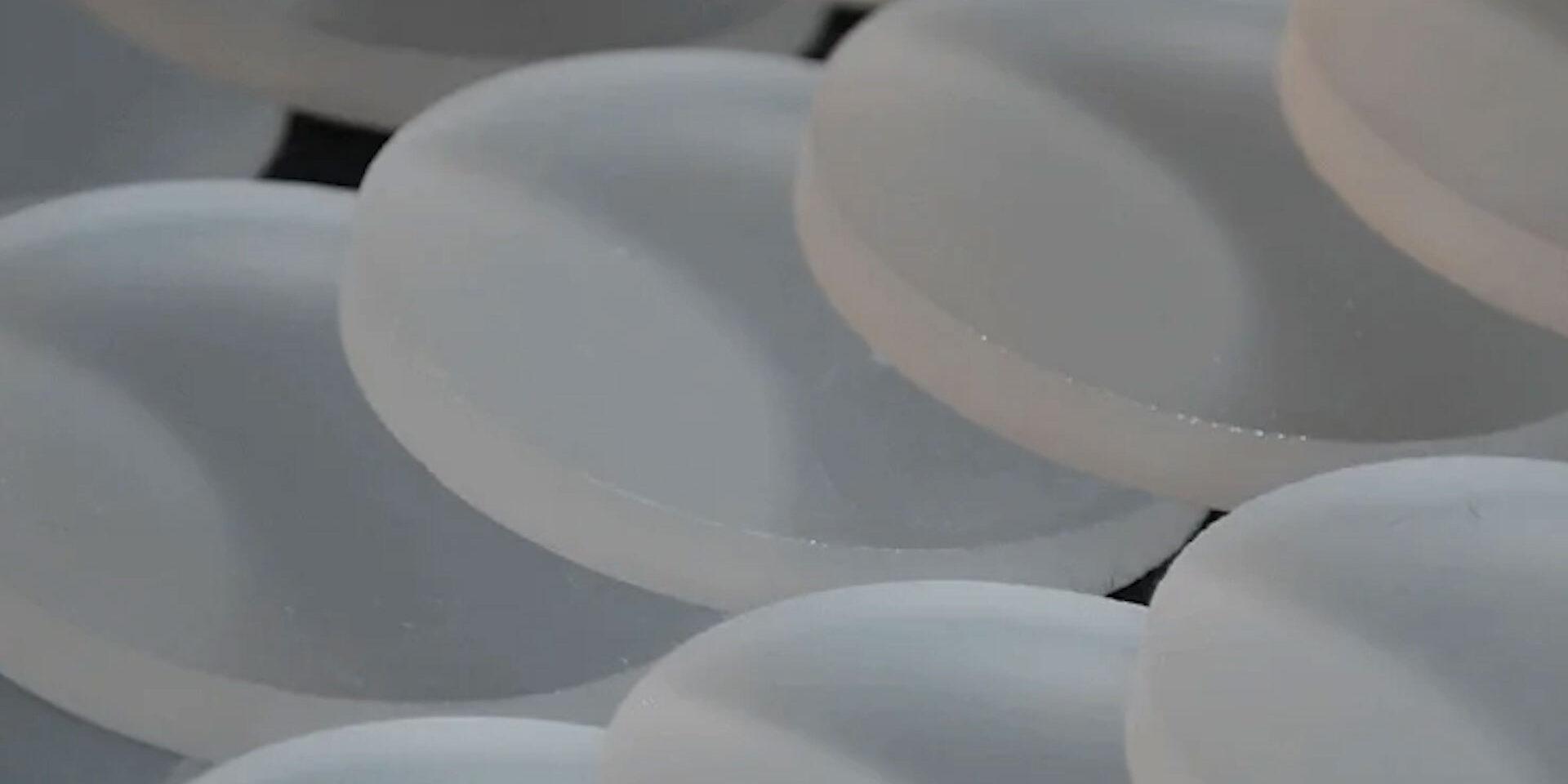
- After this step, the glass looks frosted due to all the tooling marks.
Step 2
Shaping the Mold
During the fining process, we use sphere polishers which rotate in place instead of moving back and forth like the polishers used on prescription lenses. Since glass is very hard, we rely on diamond tools and abrasive liquids to achieve an ultra-smooth, optical-quality surface.
Step 3
Polishing to Optical Clarity
Once the glass mold has been shaped, it's polished using a sphere polisher and an abrasive liquid. Unlike a toric polisher, the sphere polisher rotates in place, which allows it to produce a consistent, uniform curve across the surface.
This step transforms the frosted glass into an optically clear surface, and that clarity is essential: any haze left on the mold would carry over to the lens, so a properly polished mold is what makes it possible to cast a clear lens blank.
Next sTeps
Ready To Cast
Before a mold is approved, its curves are verified using sag gauges and specific equations to confirm they meet precise specifications.
Once the measurements check out, the mold is de-blocked, meaning the block that served as its handle during grinding and polishing is removed.
The finished mold is then sent to the lens casting department, ready to produce lens blanks.