

Equivalent Power Calculator
This calculator determines the true net refractive power of a thick lens or two separated lenses working together, accounting for the fact that light shifts and bends between surfaces rather than simply adding powers together (as a simple thin-lens calculation would assume). It applies Gullstrand's law to reflect that separated or thick optical systems actually deliver slightly less net power than the sum of their individual parts.
The tool offers two modes: Two Lens System, which calculates net power for two separate lenses using the distance between them and the index of refraction of the medium (typically air), and Thick Lens, which analyzes a single substantial lens blank using front and back surface power, center thickness, and the lens material's index of refraction. Use this to accurately predict the true focal outcome of multi-lens devices, high-power microscopes, or thick spectacle lenses without manual calculation errors.
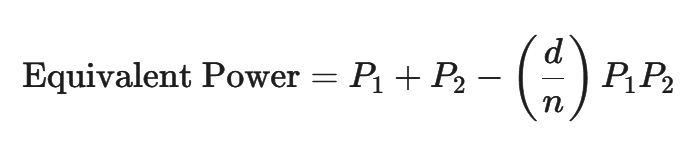
Unlike simple thin-lens calculators that assume lenses have no physical thickness and can just be added together (like 3+6=9), this tool accounts for Gullstrand’s law of geometric optics. When light passes through a front optical surface, it begins bending before it ever reaches the second surface. Because the light path shifts over that physical distance, the simple sum of the two powers is altered, meaning a separated or thick optical system actually exerts slightly less net power than its individual parts would suggest.
The tool provides two operating modes depending on the system you are analyzing:
- Two Lens System: This mode calculates the net power of two distinct lenses positioned in sequence (such as a telescope setup, a trial lens frame combo, or a magnifier held a specific distance away from a pair of glasses). It uses the Distance between Lenses and the Index of Refraction of the medium between them (standardly 1 for air).
- Thick Lens: This mode analyzes a single, substantial lens blank. In this variation, the inputs represent the front surface power, the back surface power, the center thickness of the glass or plastic, and the index of refraction of the lens material itself (such as 1.498 for CR-39 or 1.586 for polycarbonate).
By taking these physical gaps into account, the calculator processes the necessary reduction formula:
This tool is a fundamental asset for lens designers, optical laboratory technicians, and low vision specialists. It allows them to accurately predict the true focal outcomes of complex multi-lens devices, high-power microscopes, and thick spectacles without manual trigonometric or algebraic errors.
DID YOU FIND THIS HELPFUL? CHECK OUT WHAT ELSE WE CAN DO.