

The Peli Lens™
The Peli Lens™ is a prism lens built specifically for patients with homonymous hemianopia, the loss of one half of the visual field that often follows a stroke, traumatic brain injury, or other neurological event. Instead of correcting vision the way a typical prescription lens does, it uses high-powered prisms placed along the patient's blind side to shift objects and movement into their seeing field, alerting them to what they'd otherwise miss.
That added awareness helps patients navigate more confidently, avoid obstacles, and move through daily life with far less anxiety about what's happening just out of sight.
The Details
How The Peli Lens™ Works
The Peli Lens™ uses high-powered prisms that expand a hemianopic patient’s awareness of their blind side by over 30 degrees, helping them with peripheral vision loss attributed to Homonymous Hemianopia. This awareness enables patients to better detect obstacles and navigate around them.
The goal of the Peli Lens™ is to help patients make the most use of their remaining vision. By placing peripheral prisms in the patient’s blind side, they can notice movement and contrast from their missing visual field so they know to turn and look in that direction. This often enables patients to significantly increase their awareness of their blind side.
Below you’ll see a view from above of how a hemianopic patient’s visual looks normally and how the field looks while wearing the Peli Lens™.
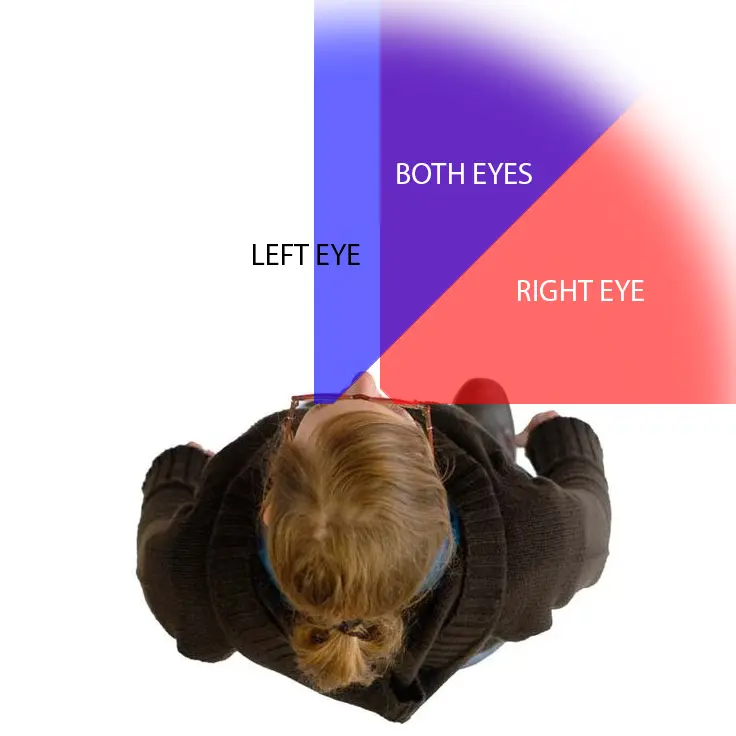
Homonymous Hemianopia
Visual Field
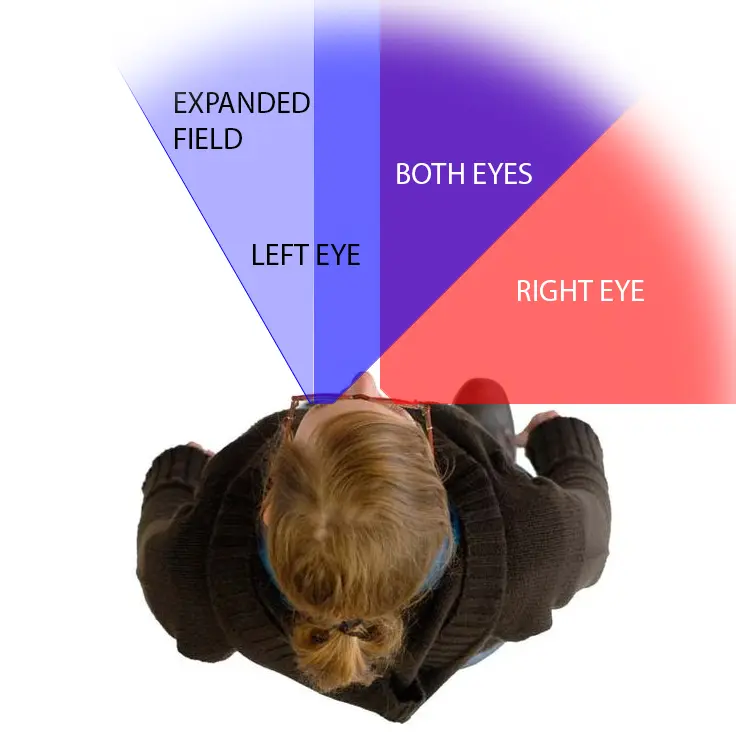
Homonymous Hemianopia
with the Peli Lens
ON THE MOVE
Built for Getting Around
When to use the Peli Lens
The Peli Lens™ is designed to be worn as a mobility device. Because the peripheral prisms can hinder patients during certain activities such as reading, computer use, and watching TV, fitting peripheral prisms on a pair of glasses the patient wears all the time is not advised. It is important that the patient be able to choose when to wear the lens. Adapting to prisms can be very disorienting at first, which is why we highly recommend training your hemionopic patient with a range of exercises created to get them used to wearing their Peli Lenses.
Why We Recommend the Peli Lens™
It's simple. Because it is the best solution out there, hands down. There are other options, but honestly, they don't really work. Or, more to the point, they don't provide the kind of relief and assistance someone suffering from this condition would really need. If you want to learn why, we put together a handy primer here.

IN THEIR WORDS
A PATIENT'S STORY
"My nephew lost the right half of his visual field in both eyes after brain surgery. He visited several clinics for examinations and diagnostics, and each one told him the same thing — that the damage was irreversible and that no aid existed that could help him regain even partial vision or spatial awareness on his blind side.
We live in Croatia, which, although a member of the European Union, does not have the same level of access to medical care and assistive devices as other EU countries - or even many other countries elsewhere in the world. While searching online, I came across Peli lenses, which are designed to help people with hemianopsia significantly expand their visual field and awareness on the blind side.
Working with my optometrist, I purchased temporary Peli lenses through Chadwick Optical. Within just a few days, my nephew became aware of part of the space on his blind side. He had no difficulty adjusting to them, so after 10 days, we began the process of ordering permanent Peli lenses.
Since we were unable to travel to Pennsylvania, we arranged a Google meeting with Mr. Charlie Saccarelli, President of Chadwick Optical. We agreed that my nephew's part of the process could be done with an optometrist in Croatia, and all relevant information would be sent to Chadwick Optical. Just a week later, the clip-ons with the installed PERMANENT OBLIQUE PELI LENSES arrived!
My nephew is overjoyed — and so are we. His quality of life has improved tremendously. He is once again independent in his movements. Public transport is no longer a challenge. He's even considering driving again!
Thanks again to everyone at Chadwick Optical!"
- Mirjana, Croatia
The Process
Getting the Peli Lens™
Do you think your patient would benefit from the Peli Lens™? If so, we recommend the following steps to make the most of it. Once you determine if it’s for sure the right solution for your patient’s vision issues, getting the lenses is straightforward and simple.
- Determine the patient’s loss of vision, what is causing it, and whether it is an issue the Peli Lens™ can address.
If the Peli Lens is a good option… - Discuss the benefits of the Peli Lens™ with your patient and demonstrate to them how to use the Peli Lens™ in-office using our Peli Evaluation Kit (more on this shortly...)
- Provide fit training prisms for your patient*
- Monitor routine at-home training
- Order the full-power Peli Lens™
The Peli Lens™ should only be fit by or under the direction of a physician or other qualified ophthalmic professional. - Any prism can be disorienting to patients when they first try them, and the Peli Lens™ is no different, which is why we recommend that a patient wear training prisms for 4-to-6 weeks and spend about 20 minutes a day performing self-training exercises to help with adaptation. To make it easier, we’ve created a training protocol to help patients with this process. You can access it and tons of other useful information here.
- Once your patient has successfully completed a 4-to-6 week trial of the Peli Lens™, we recommend moving to the best option for long-term use: full-power prisms. These prisms offer increased field expansion in a more durable, resilient, and effective form than temporary prisms.
The Kit
The Peli Evaluation Kit (PEK)
So, how does it work? Easy. Your patients take the Peli Lens for a test run so they can see the before and after effects of the Peli Lens, and YOU get the chance to perform a subjective assessment on your patients and their experience using the lens. That’s it.
The kit provides you with a modern fitover and two lenses attached by magnets, which, when attached to glasses, enable you to test horizontal or oblique peripheral prisms on either eye.
NOTE: Training prisms are exactly that – a tool to help patients ensure that peripheral prisms are right for them and a way to integrate the benefit into their everyday lives before investing in the full-power Peli Lens. Training prisms are meant to be used for a maximum of 4 to 6 weeks. Once the patient accepts the benefit of training prisms, they’re ready to move on to full-power prisms, which will offer roughly twice as much field expansion in a more durable, portable format.
S.L.A.M.
S.L.A.m. Single LENS ATTACHED BY MAGNETS
While we can embed Peli Lens peripheral prisms into nearly any lens, some people just don’t want to carry a bulky fitover or don’t want to deal with a fragile clip-on lens. Being the tinkerers that we are, we set to work and think we’ve found a solution: our Single Lens Attached by Magnets (SLAM) device. SLAM technology enables us to create a single removable lens that attaches to your patient’s glasses lenses via magnets.
The Peli Lens using SLAM technology offers:
- Staying Power: our Peli SLAM solution stays put even when vigorously shaken or jostled
- Durability: designed to last for years to come, the Peli SLAM is a rugged, highly durable option for patients on the go
- Comfort: a single lens weighs less than all other options, offering maximum comfort when worn
- Portability: at less than the size of a business card, the Peli SLAM lets your patient easily take it with them wherever they go
- Flexibility: patients can wear the Peli SLAM when they need and simply remove it when they don’t
- Versatility: patients can wear the single lens over their normal glasses or over their sunglasses, making it ideal for both daytime and nighttime use
Best of all? Your patient can continue to use the Peli SLAM even if their prescription changes (provided they retain their original frames). This makes the Peli SLAM a permanent, cost-effective solution for patients in the long run.